
Crinkle Paper vs Shredded Paper: Uses, Differences & Void-Fill Guide
Crinkle paper and shredded paper are often used to fill space, separate products and improve presentation in gift boxes or shipping cartons. They are not automatically equivalent. Cut shape, paper weight, volume, settling, cleanliness and the job inside the package affect performance. This guide explains how to select, test and use each type without confusing decorative fill with engineered cushioning.
An independent, practical guide for buyers, packaging teams and operations managers. The right specification depends on the actual product, handling route and business requirements.

1. What are crinkle paper and shredded paper?
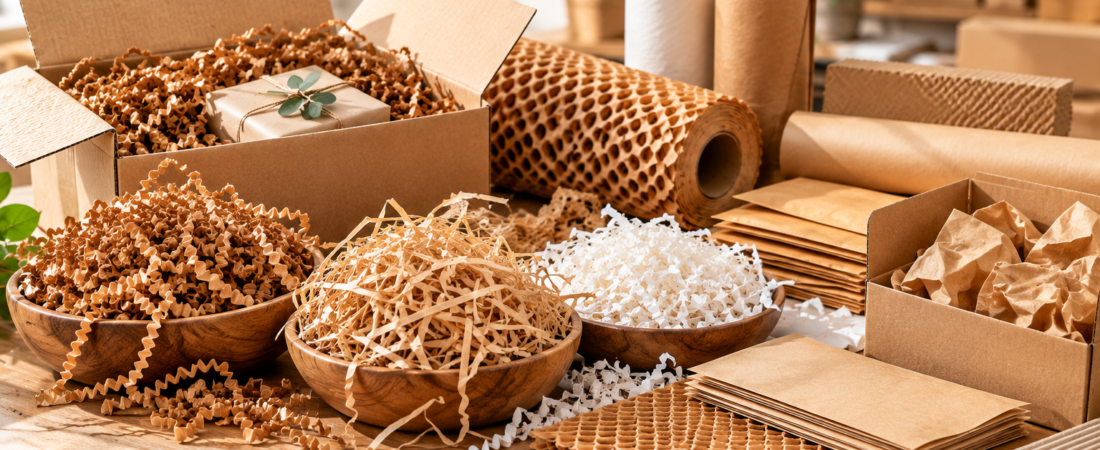
Crinkle paper is typically paper cut into narrow strips and processed to create a crimped or zigzag texture. Its springy shape can create volume and help fill gaps in presentation boxes or suitable parcels.
Shredded paper is a broader term for paper cut into strips or small pieces. It may be straight, narrow, wide, fine or irregular depending on the equipment and specification. Because the term covers many formats, ask for a sample and exact description before comparing quotes.
Suppliers may use these names differently. Confirm strip width, cut length, paper weight or grammage, colour, source material, dust level and whether the product is intended for decorative presentation, void fill or another specific job.
2. Void fill is not the same as impact cushioning
Void fill occupies empty space and may help keep a product from moving. Cushioning is intended to reduce the force transmitted during impact. A material can contribute to both functions in some pack designs, but loose paper fill can settle or compress, leaving gaps that allow movement.
For fragile or heavy goods, do not assume that filling a carton to the top makes it protective. The product may still move within the fill, and the material may compress under load. Use a suitable inner wrap, insert or purpose-designed cushioning where required, and test the complete package.
3. Practical comparison
| Factor | Crinkle paper | Shredded paper |
|---|---|---|
| Appearance | Textured, spring-like volume often used in presentation boxes. | Varies from fine strips to broader or irregular cuts. |
| Volume per weight | Can create a visually full presentation due to the crimped structure. | Depends strongly on strip size, paper weight and packing density. |
| Product restraint | May help surround light items, but can settle or compress. | May fill gaps; restraint depends on cut, quantity and pack design. |
| Surface contact | Check for dust, rough edges or colour transfer. | Check for dust, loose fibres and contact marks. |
| Best decision basis | Trial the actual product and presentation requirements. | Trial the exact cut and paper specification. |
4. Match the fill to the product
Gift hampers and presentation boxes
Crinkle paper can create a decorative base and help position lightweight items. Ensure the products are still secured and cannot collide. Presentation appearance should not override protection.
Lightweight, non-fragile items
Loose fill may be suitable to occupy gaps when the item is not vulnerable to compression or movement. Check the closed carton and confirm the product remains in place after handling.
Glass, ceramics and polished surfaces
Wrap items separately before adding loose fill. Keep dust or rough paper edges away from sensitive finishes. Use dividers or fitted supports if multiple pieces could strike each other.
Heavy products
Loose crinkle or shredded paper alone is often unreliable as the primary restraint for heavy goods because it may compress and shift. Consider stronger inserts and a carton designed for the load.
5. A consistent filling method
- Choose the carton and measure the gap around the protected product.
- Wrap or separate the product where surface contact or breakage is a risk.
- Add fill in controlled amounts rather than dumping in a random volume.
- Place the product so it cannot touch the carton walls or another item at vulnerable points.
- Fill side and top gaps without applying excessive pressure to the product.
- Close the carton and gently test for movement or rattling.
- Open a sample pack after handling to inspect settling and contact points.
For multi-item orders, consider compartments. Loose fill alone may not stop two heavy or hard objects from moving toward each other.
6. Compare cost by usable pack, not just per kilogram
Compare cost per carton after accounting for the quantity used, density, packing time, storage volume, dust or offcuts, freight and damage outcomes. A material with a low price per kilogram may occupy less volume or require more weight per pack. A highly voluminous fill may reduce the amount used but take more storage space.
During a trial, record the amount used for each product type and the time required to position the items. Calculate a repeatable target quantity or use a visual fill-level reference for staff. Review actual damage and customer feedback before making a large material change.
7. Quality, storage and handling
Keep loose paper fill dry, clean and covered. Protect it from moisture, dust, pests, strong odours and crushing. For products where cleanliness matters, define acceptable dust and fibre levels and inspect each incoming batch. If coloured fill is used, check for colour transfer on light-coloured or moisture-sensitive products.
Do not assume that paper fill is recyclable in every local system. Check whether the recipient can separate it from tape, coatings, food residues or mixed packaging. Avoid broad environmental claims unless the material composition and local disposal conditions support them.
8. Buyer’s checklist
- Define whether the need is presentation, gap filling, restraint or cushioning.
- Specify cut type, strip width, paper weight, colour and quantity.
- Test surface contact and colour transfer on actual products.
- Check settling after the pack is moved or tilted.
- Measure material consumed and packing time.
- Use separate wrapping or inserts for fragile and heavy items.
- Confirm storage volume, cleanliness and replenishment needs.
- Review the complete package before approving bulk use.
Choosing void fill by the job it must perform
Is crinkle paper the same as shredded paper?
The terms overlap in everyday use. “Crinkle paper” commonly refers to narrow strips with a curled or springy shape, often used in gift boxes and presentation packaging. “Shredded paper” is broader and may mean straight strips, fine shreds or paper fragments made for filling space. The cut, stiffness, strip width, material and consistency affect how the fill behaves. When ordering, request a sample or specify the cut and intended use rather than relying on the product name alone.
Void fill is not the same as cushioning
Void fill reduces empty space and helps limit movement, but it does not necessarily absorb impact effectively. Lightweight crinkle paper can compress or settle under a heavy object, leaving a gap that allows the product to move. If the product is fragile or heavy, use an insert or a cushioning design that supports the load and test the completed pack. For lightweight gift items, presentation may be an important goal; for heavy products, restraint and load support matter more.
How much paper fill should I use?
There is no universal weight or handful count. The amount depends on the box volume, product shape, fill density and how much movement must be controlled. Fill the gaps without forcing the carton closed or compressing delicate contents. After packing, gently tilt the carton and listen for movement. Then unpack a trial unit to check whether the fill has settled or marked the product. These checks are useful screening steps, not a replacement for transit testing where damage risk is high.
Can crinkle paper touch food or cosmetics?
Do not assume decorative paper is suitable for direct contact with unpackaged food, cosmetics or other sensitive products. Food-contact suitability depends on the exact material, inks, dyes, coatings, contamination controls and applicable rules. If direct contact is possible, obtain documentation for the intended use or place the product in a suitable primary package. “Paper” and “non-toxic” are not, by themselves, proof of food-contact compliance.
How should paper fill be stored?
Keep it clean, dry and protected from dust, odours, pests and moisture. Avoid storing open bags beside chemicals, strongly scented goods or areas where fibres can become contaminated. Use a first-in, first-out rotation and close partially used packs. Damp or compressed fill may lose its spring and may transfer moisture to the packed item.
Selection checklist
- Is the main purpose presentation, separation, void filling or impact cushioning?
- Will the product’s weight compress or displace the fill?
- Can loose strips escape through gaps or contaminate the product?
- Is direct contact allowed for the intended product?
- Can the customer separate the fill from other packaging for disposal?
- Has the filled parcel been checked for movement and settling?
Troubleshooting common void-fill problems
The product rattles after packing: do not keep adding loose paper until the sound disappears. Check whether the item needs a fitted insert, divider or a more supportive cushioning material. A quiet box is a useful screening sign, but it does not prove the pack will survive a drop.
Fill is flattened when the customer opens the parcel: some compression is normal, but excessive settlement can indicate that the fill was carrying a load it was not designed to support. Keep heavy products on a suitable base or insert rather than relying on lightweight decorative strips.
Paper fibres stick to the product: check the paper’s cut quality, cleanliness, colour transfer and whether the product finish is tacky or static-prone. Test contact with the real item before switching to bulk use.
The box looks full but damage still occurs: a full carton can still transmit impact directly to a product. Check whether cushioning is positioned at the vulnerable points and whether it can compress without bottoming out.
Packaging takes too long: standardise a repeatable amount and packing sequence, pre-cut material where sensible, and use a container that fits the product. Time the full packing process rather than judging only material cost.
Can I reuse clean paper as void fill?
Potentially, if the material is clean, dry, consistent and suitable for the product and shipping risk. Avoid paper with staples, sharp folds, ink transfer, food residue, oil or strong odours. Reused material can vary in stiffness and size, so document what is acceptable and do not mix unknown paper into sensitive or regulated applications.
Questions buyers should ask before ordering paper fill
Ask for the strip style, approximate cut dimensions, paper type, colour consistency, packing format and storage recommendations. If the fill is sold by weight, compare the quantity and usable volume rather than assuming equal weights occupy equal space. A lighter, springier cut may fill a larger volume, while a denser cut may behave differently in a box.
Ask whether the product is intended mainly for presentation or whether the supplier has data for a specific protective application. If it is intended for a sensitive product, clarify whether inks, dyes or other treatments are present and whether direct contact is appropriate. Decorative appearance is not proof of food-contact compliance or impact performance.
When testing a new fill, document the amount used per box and whether it stays in place after handling. If the same product is packed by multiple people, write down a practical target and train the team to follow it. This improves consistency and makes cost comparisons more meaningful.
A practical way to compare void-fill costs
Suppose Fill A costs less per kilogram but requires more material per parcel, while Fill B costs more per kilogram but occupies more useful volume per unit of weight. The price per kilogram alone cannot identify the cheaper option. For a trial batch, weigh the material used for each packed order, record its purchase price, and calculate material cost per parcel. Add packing time and any change in parcel size.
Then assess performance separately. A low-cost fill that settles and allows breakage may not be acceptable; a premium decorative fill may not be justified for a product that needs only simple separation. Compare the same order type, packing method and protection requirement. Keep presentation value, protective function and cost as separate decision criteria.
Practical selection questions
Is crinkle paper the same as shredded paper?
Not always. Crinkle paper usually means paper strips processed into a springy zigzag; shredded paper may be straight, narrow, wide or irregular. Suppliers use terms differently, so ask for a sample, strip dimensions, paper type and pack weight. The product name alone is not a performance specification.
Can loose paper fill protect glass on its own?
Loose fill mainly occupies void space and can limit movement; it is not automatically engineered impact cushioning. Strips can compress, shift or settle during transit. Glass, ceramics and other fragile goods may need a shaped insert, divider or cushioning system that controls movement and manages impact. Test the closed pack rather than judging the fill in an open gift box.
How much fill is required?
Measure a correctly packed sample and weigh the fill used. If one order consumes 18 grams and you ship 500 similar orders, the baseline is 9 kg before process variation and waste. This estimates consumption, not protection performance. Recheck different carton sizes and order combinations.
Presentation versus protection
Gift boxes may need consistent colour, low dust and attractive appearance. Shipping cartons need fill that remains in place and helps control movement. Decorative volume is not proof of impact protection. Check colour transfer, loose fibres, odour, cleanliness and shedding when the product has a delicate finish.
Common failure signs
- Fill settles: use a more stable insert or revise how the void is filled.
- Product rattles: improve pack geometry or add dividers; fill may not restrain it.
- Surface scratches: add compatible inner protection and check fibres.
- Messy presentation: standardise fill weight and loading sequence.
- Dust or contamination: check supplier cleanliness and storage.
- Variable cost: set a target amount and weigh portions.
Run a fair comparison
- Use the same product, carton and pack arrangement.
- Record material weight and packing time.
- Check movement in the closed carton.
- Test fragile packs appropriately and inspect the item afterwards.
- Record cleanup time, dust, material loss and presentation.
- Compare cost per successfully packed order, including labour and damage data when available.
Do not compare only price per kilogram or bag. A cheaper fill may need more volume, labour or additional inserts. Compare the complete pack performing its intended job.
Choosing fill for different product types
For lightweight gift items, the priorities may be presentation, separation and keeping small accessories from moving. For heavy objects, loose strips may compress or migrate, so a more stable insert or blocking arrangement may be necessary. For fragile ceramics, use a system that prevents direct contact with the carton and limits movement in all directions. For products with delicate coatings, test for abrasion, fibres and colour transfer. For products that must remain clean, assess dust and contamination before approving any loose fill.
Keep a repeatable packing standard
Document the target amount of fill, the placement sequence, whether the product is wrapped separately and how the box should feel when closed. Train operators using a real sample and inspect early orders after a new material is introduced. Track complaints and damage by SKU rather than combining every product into one total. If the packing method changes, record the date and reason so performance can be compared fairly. Consistency is especially important when different staff pack the same product on different shifts.
FAQs
Is crinkle paper always better for gift boxes?
It often provides a distinctive presentation, but the best choice depends on appearance, restraint, product weight, dust tolerance and cost.
Can shredded paper protect glass on its own?
Do not assume so. Individually wrap and separate glass, then test the complete package under representative handling.
How much fill should I use?
Use enough to control movement without forcing pressure onto the product. Measure and document the amount during a sample trial.
What should I ask a supplier?
Ask for cut dimensions, paper weight, colour options, cleanliness, packaging format, MOQ, lead time and a sample of the exact grade.
Looking for practical packaging options for your business?
Explore our packaging products or request a bulk quote for your requirements.