
Honeycomb Paper vs Bubble Wrap: How to Compare Protective Packaging
Honeycomb paper and bubble wrap can both help protect goods, but they work differently and are not interchangeable in every application. This guide explains construction, protection, packing workflow, cost, storage, disposal considerations and how to run a fair product-level trial before changing materials.
An independent, practical guide for buyers, packaging teams and operations managers. The right specification depends on the actual product, handling route and business requirements.

1. What each material is and how it behaves
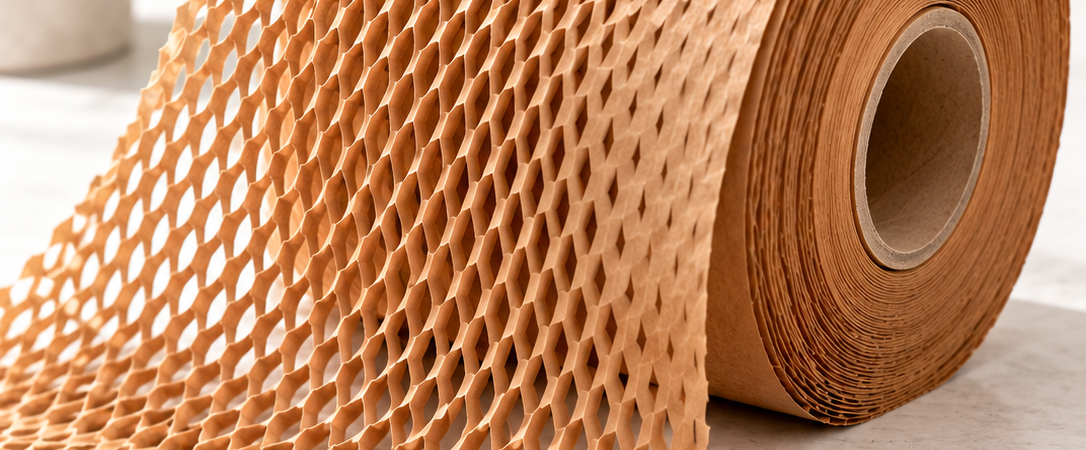
Honeycomb paper is a paper-based wrap that expands into a three-dimensional mesh when pulled apart. The interlocking structure can grip the product and create a cushioning layer. It is usually supplied as a roll and is stretched and overlapped during packing. Results depend on paper weight, expansion, wrapping technique and the number of layers used.
Bubble wrap is a plastic film with sealed air-filled pockets. The bubbles provide a cushioning layer and can help separate the product from surrounding surfaces. Bubble size, film thickness, bubble integrity and the number of layers affect performance.
Neither material has one universal protection rating. A material that works well for a light ceramic cup may not be suitable for a heavy stone object, a sharp-edged component or an item that must withstand high stacking pressure.
2. Separate the jobs a package must do
Packaging usually needs to address several different risks. Surface protection reduces scratching and rubbing. Cushioning helps manage shock. Void fill limits empty space. Restraint prevents the product from building momentum inside the carton. A corrugated outer box contains the pack and resists handling and stacking loads. Do not assume either honeycomb paper or bubble wrap alone performs every job.
| Requirement | Questions to ask | What to validate |
|---|---|---|
| Surface protection | Can the finish scratch, scuff, stain or transfer colour? | Test the inner contact layer on the real finish. |
| Impact cushioning | How fragile is the product and how much does it weigh? | Test the complete pack under representative handling. |
| Movement control | Can the item slide, rotate or hit a carton wall? | Check the closed pack for movement and rattling. |
| Edge protection | Are there handles, corners, stems or thin projections? | Add local protection or fitted inserts where needed. |
| Moisture protection | Could water, humidity or condensation damage the item? | Choose a suitable moisture strategy separately. |
3. Match the wrap to the product
Lightweight, non-sharp products
Honeycomb paper may be practical where a paper-based wrap can grip the item and the outer carton provides the required protection. Bubble wrap may be useful when the product needs a soft layer with consistent separation. The actual pack should be tested for abrasion and movement.
Polished, painted or delicate surfaces
Do not place a textured material directly against a finish without checking compatibility. Dust or trapped grit can scratch a surface even when the wrap itself feels soft. Use a clean, suitable inner barrier where needed, then add the cushioning layer outside it.
Heavy or brittle products
Weight and concentrated loads matter. Wrapping a heavy item does not automatically stop it from striking the carton wall. Consider shaped inserts, dividers, stronger cartons and engineered cushioning. Validate the pack under realistic drop, vibration and compression conditions.
Irregular shapes and projecting parts
Honeycomb paper can conform around some contours when stretched correctly; bubble wrap can also be shaped around many products. Neither should be expected to bridge unsupported gaps or protect a fragile projection without extra support. Protect projections individually and prevent pressure from being concentrated on them.
4. Common limitations and failure modes
- Insufficient coverage: exposed corners or seams become contact points.
- Inadequate overlap: wrap can loosen or open during handling.
- Excessive compression: cushioning may be crushed or pressure may damage the product.
- Loose packing: the item gains momentum and strikes the carton wall.
- Wrong outer box: wrap cannot compensate for a weak, oversized or damaged carton.
- Uncontrolled technique: different operators use different amounts, tension and overlap.
For bubble wrap, inspect whether bubbles are crushed or punctured and whether the product can still move. For honeycomb paper, check that the mesh has been expanded as intended and that overlap and tension are consistent. For both, inspect the full package rather than judging the wrap alone.
5. A repeatable packing workflow
- Record the product dimensions, weight, finish and vulnerable features.
- Choose the inner contact layer based on surface sensitivity.
- Apply the selected wrap consistently, protecting edges and projections.
- Place the wrapped product into an insert or carton with appropriate clearance.
- Fill gaps and restrain movement without crushing the product.
- Close the carton using a repeatable sealing method.
- Check movement, rattling, exposed surfaces and carton integrity.
- Record the material quantity and packing time per unit.
6. Compare total cost—not just roll or sheet price
A fair comparison includes the amount used per parcel, labour time, tape and accessories, storage footprint, damage and return rates, disposal practices and the cost of switching equipment or training. A cheaper material per metre may require more layers or more labour. A paper-based material is not automatically lower-cost or lower-impact in every application; the result depends on usage and the end-of-life system available to the recipient.
Track a representative sample of shipments for each method. Record material used, seconds per pack, damage type, customer complaints and any additional inserts. Compare like-for-like product types and routes rather than mixing light and heavy items into one average.
7. How to run a controlled packaging trial
- Choose a small set of representative products, including the most fragile or awkward shape.
- Keep carton size, product quantity and dispatch route as similar as possible between test groups.
- Write down the exact wrap method, number of layers, overlap and insert configuration.
- Test movement and closure, then use a suitable internal handling test or professional transit test for higher-risk shipments.
- Inspect returns and delivered samples for chips, scuffs, crushed cartons and movement evidence.
- Set acceptance criteria before the trial and retain the approved packing instructions.
8. Buyer’s decision checklist
- What type of damage are we trying to prevent?
- Does the wrap touch a sensitive finish?
- What are the packed product’s weight and dimensions?
- Are corners, handles or protrusions supported?
- Does the product move inside the closed carton?
- Will the outer carton tolerate stacking and handling?
- How much material and labour does each pack require?
- Can our team reproduce the method consistently?
- What disposal or recycling routes actually exist for our customers?
- Have we tested the full package on representative products?
How to compare honeycomb paper and bubble wrap fairly
First define what “protection” means for your product
Protection can mean preventing scratches, reducing impact, keeping pieces separated, stopping movement, protecting against moisture or presenting the item neatly. One material may perform well at one job and poorly at another. Before comparing options, write down the damage you are trying to prevent and the actual shipping conditions.
Do not compare by appearance or thickness alone
Honeycomb paper expands when stretched and can conform around suitable products; its performance depends on paper weight, cell geometry, stretch and wrapping technique. Bubble wrap performance depends on film construction, bubble size, thickness and whether the bubbles remain intact. A thicker-looking layer does not prove better protection. Compare the materials in the same complete package with the same product, carton and test conditions.
What about moisture and humidity?
Plastic bubble wrap can resist liquid water better than uncoated paper, but the entire parcel still has seams, openings and possible condensation. Paper may soften or lose some performance when damp. If the shipment faces rain, high humidity, condensation or wet handling, assess the whole packaging system and use appropriate moisture protection where needed. Do not assume either material alone makes the parcel waterproof.
Which is easier to store and apply?
Expandable honeycomb paper can be stored in roll form and expanded during packing; bubble wrap is generally stored in its full-volume form. Actual space savings depend on roll size, expansion, order volume and replenishment. Application speed depends on the product, operator, required layers and whether cutting or tape is needed. Time a representative packing run rather than assuming one method is faster.
How to run a useful comparison test
- Use the same product type and inspect it before packing.
- Use the same outer carton, shipping configuration and closure where possible.
- Follow a written method for each material and record material quantity and packing time.
- Test the complete packs using a suitable handling or distribution test.
- Inspect for breakage, scratches, movement, torn material and carton damage.
- Repeat with enough samples to avoid basing a decision on one lucky result.
Comparison checklist
- Protection need clearly defined.
- Product weight, shape and finish considered.
- Moisture and route conditions assessed.
- Storage, packing speed and material usage recorded.
- Recycling or disposal claims checked for the exact construction and local system.
- Decision based on complete-pack results, not broad claims.
Common mistakes when comparing protective materials
Comparing price per metre only: roll width, number of layers, material use per packed product and packing labour can reverse the apparent saving. Calculate cost per successfully packed unit.
Testing only the wrapping layer: protection depends on the outer carton, internal clearance and whether the product can move. Test the complete parcel.
Using one product to represent every SKU: a material that works well on a smooth, lightweight item may fail around a sharp corner or heavy component. Choose representative high-risk products for the trial.
Assuming paper is always better environmentally: compare the exact materials, amount used, damage outcomes, local collection and disposal. If a change causes more breakage and replacement shipments, the overall result may be worse.
Ignoring packing technique: a suitable material can fail when it is not expanded or wrapped correctly. Record the wrapping method and train staff before judging the material itself.
How do I know when a material change is worth it?
Set pass/fail criteria before the trial. For example: no damage in the agreed test, no unacceptable surface marks, packing time within an operational limit and total cost within the business target. The exact criteria depend on the product and risk. Keep the results so future changes can be compared with the same baseline.
Questions that make a material trial fair
Ask what each material is designed to do, what specification is being supplied and whether the supplier can provide handling guidance. Confirm roll width, length, material weight or construction, bubble size or other relevant characteristics. Product names alone are rarely enough to establish equivalent performance.
Use the same product and outer carton, but allow each material to be applied according to its proper method. Record the quantity used, packing time, final parcel size and observed result. A test is unfair if one material is used incorrectly or if one pack receives more protection than the other. If results vary, repeat the trial and examine the damage pattern rather than choosing based on a single outcome.
Finally, include the full end-of-life context. Check whether the local waste system accepts the specific paper or plastic components, whether components need separating and whether contamination affects disposal. Avoid blanket claims that one material is always the better environmental choice.
A decision framework for choosing between materials
Start with mandatory requirements: the product must arrive undamaged, surfaces must not be scratched, and any moisture or cleanliness requirement must be met. Eliminate options that fail these requirements in testing. Then compare packing speed, storage volume, material consumption, final parcel size, disposal route and total cost.
Keep the results in a simple table with one row per material and one column per measure. Record the actual configuration rather than writing only “paper” or “plastic.” If the trial changes the number of layers or carton size, note that clearly because the comparison is no longer one material versus another in isolation. It is a comparison of two complete packaging systems.
Questions to resolve before switching materials
Is honeycomb paper always more sustainable?
There is no universal answer from the material name alone. Consider construction, amount used, damage rate, local collection options, contamination, transport and end-of-life route. Paper may fit some recovery systems more readily, but the complete pack and local rules matter. Substantiate environmental claims rather than treating “paper” as proof.
Which material protects better against impact?
Neither label guarantees performance. Expanded honeycomb paper can protect suitable surfaces when applied correctly. Bubble wrap cushions through air cells, but results depend on bubble size, film quality, layers, product geometry and wrap method. Compare the actual product, wrap pattern and outer carton under relevant handling conditions.
What about heavy, sharp or delicate products?
Heavy items can compress or displace lightweight wrapping; sharp corners can puncture material; delicate finishes can scratch. Consider corner protection, edge guards or shaped inserts. Restraint, cushioning and surface protection are separate functions, and one thin wrap should not be expected to perform every job.
Compare real cost
Include material used per product, wrapping time, storage, waste, consumables, training and damage-related costs. A material that costs ₹2 more per pack but saves 20 seconds may be worthwhile at high volume; a cheap option that needs extra layers may not be. Use measured results, not assumptions.
Moisture and disposal
Paper wraps can be affected by moisture; plastic film can be punctured and may not be collected locally. Consider humidity, rain exposure, condensation, export transit and local waste infrastructure. Store materials properly and avoid end-of-life claims that do not match local facilities.
Run a fair trial
- Select representative products, including fragile, heavy and scratch-sensitive items.
- Define the required protection goal.
- Document layers, overlap and material consumption.
- Use the same outer carton and inserts unless comparing complete systems.
- Record time, waste, storage and final parcel dimensions.
- Apply a suitable distribution-test protocol and inspect products afterwards.
- Compare cost per successful shipment and repeat if results vary.
When a hybrid pack makes sense
A paper wrap may protect the finish while a shaped insert restrains movement; corner guards can protect edges while a carton manages stacking. A hybrid is not automatically better or worse environmentally. Assess each component’s role, amount used, separation for disposal and whether the system reduces damage. Trial a limited SKU group before changing the entire catalogue.
What evidence should a business collect?
Record the baseline before switching: material consumption, time per pack, parcel dimensions, damage rate, returns, stock requirements and cleanup. During the trial, keep product type, carton, operator training and shipping conditions as consistent as practical. Note any change that cannot be controlled. A handful of successful parcels may be encouraging but cannot guarantee performance across every SKU or route. For high-risk or valuable products, use a suitable test plan and enough samples to understand variability.
Do not confuse material reduction with system improvement
Using fewer grams of wrap is only one outcome. If a lighter pack causes more damage, needs an extra carton or increases labour, the total result may be worse. Conversely, using slightly more material may be reasonable if it materially improves protection or reduces waste elsewhere. Compare complete systems using measured performance, not a single environmental or cost metric. State any environmental conclusion narrowly and support it with evidence relevant to the specific pack and disposal context.
FAQs
Is honeycomb paper always a replacement for bubble wrap?
No. It can be a useful alternative in suitable applications, but product weight, fragility, finish, handling conditions and pack design determine whether it is appropriate.
Does bubble wrap guarantee a product will not break?
No. Protection depends on the complete package, including carton, inserts, clearance, closure and handling conditions.
Can honeycomb paper be used directly on polished surfaces?
Only after checking the finish for abrasion and contamination risk. A clean inner barrier may be needed.
Which option is more sustainable?
That depends on material quantity, product damage, reuse, local collection and actual end-of-life processing. Avoid assuming that material composition alone answers the question.
What information should I share when asking for packaging advice?
Provide product dimensions and weight, photos of fragile points, surface type, order volume, existing carton dimensions, shipping route and examples of damage. These details make recommendations more reliable.
Looking for practical packaging options for your business?
Explore our packaging products or request a bulk quote for your requirements.